Tag Archives: Nebula

Image

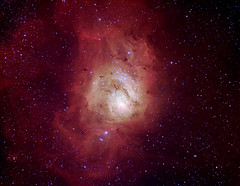
The Lagoon Nebula from Sydney

Updated version of my test image of the Lagoon Nebula (M8) with the first light of the ZWO ASI1600MM Pro camera and broad-band filters.

This image combines:

  • 39 x 120s H-alpha (Baader 3.5nm ultra-narrow filter), in red. Darks and flats included.
  • 40 x 15s OPTOLONG L-Pro filter, in green. No flat or darks.
  • 28 x 300s [O III] 3 nm ultra-narrow Antlia filter, in green. Includes darks and flat (this image is the new addition).
  • 56 x 6s ZWO B filter, in blue, no flat or dark.

H-alpha data taken on 21st Aug 2020, L-Pro and B data taken on 23rd Aug 2020, from my backyard at home, 15 km North from Sydney’s city center.

Telescope: Skywatcher Black Diamond 80, f=600mm (f/7.5)

Equipment: I used the ZWO ASIAir to control the camera, the mount (Skywatcher AZ-EQ6) and the guiding system (ASI120MM + Orion 50mm finderscope). ZWO filter drawer for changing filter.

The [O III] data taken on 18 August 2021, including the Orion 0.75x focal reducer and the ZWO 7×2″ filter wheel.

Processing: Data processed with Siril software. FITS converted on TIFF using NASA’s Fits Liberator considering a logarithmic function. Color / saturation / levels / contrast / smart sharpen with Photoshop.

Full resolution image in my Flickr.

Credit: Ángel R. López-Sánchez (AAO-MQ).
Image

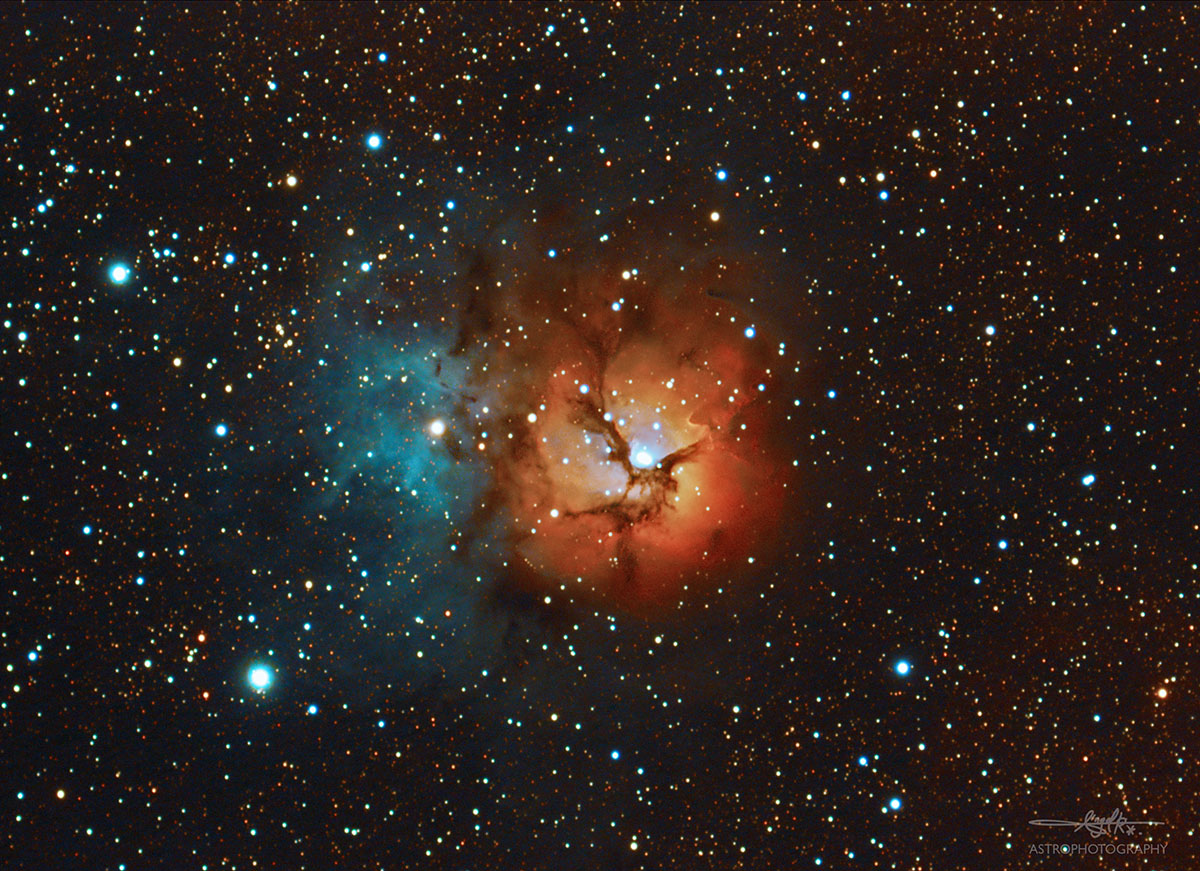
The Trifid Nebula from Sydney

The Trifid Nebula, M 20, from my backyard, 15 km North from Sydney’s city center, on 15th June 2020.

This image compiles 40 x 300s images (3.3 hours total integration time) obtained with my Skywatcher Black Diamond 80, an Orion X0.8 focal reducer (f/6), the ZWO ASI178MC camera and an OPTOLONG L-Pro filter.

I used the ZWO ASIAir to control the camera, the mount (Skywatcher AZ-EQ6) and the guiding system (ASI120MM + Orion 50mm finderscope).

Flats and darks included. Data processed with Siril software. Color / saturation / levels / contrast / smart sharpen with Photoshop.

Full resolution image in my Flickr.

Credit: Ángel R. López-Sánchez (AAO-MQ).

Image

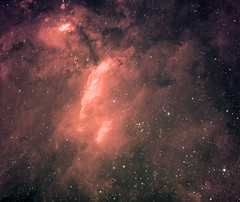
Eta Carinae and the Keyhole Nebula

Eta Carinae and the Keyhole Nebula

Diffuse gas and dust in the heart of the Carina Nebula. The bright star is Eta Carinae, a massive double star at the end of its live that will soon explode as a supernova. The “Keyhole” is the dark cloud in the centre of the image.

Image obtained as part of the “ABC Stargazing Live” events at Siding Spring Observatory (NSW, Australia), 4 – 6 April 2017.

Data taken on 3rd April 2017 using the CACTI camera in 2dF at the 3.9m Anglo-Australian Telescope. Color image using B (12 x 60s, blue) + [O III] (12 x 60 s, green) + Hα (12 x 60 s, red) filters.

More sizes and high-resolution image in my Flickr.

Credit: Ángel R. López-Sánchez (Australian Astronomical Observatory and Macquarie University), Steve Lee, Robert Patterson & Robert Dean (AAO), Night assistant at the AAT: Wiston Campbell (AAO).