Tag Archives: Nebulae

Image

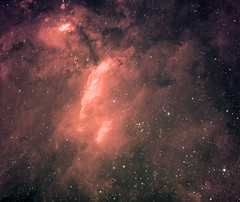
The Prawn nebula, IC 4628, from Sydney

The Prawn nebula, IC 4628, from Sydney

Deep H-alpha image of the Prawn nebula (IC 4628) in Scorpius obtained from my backyard, 15 km from Sydney’s city centre.

This image combines:

  • 56 x 900s (14h) frames with the H-alpha Baader 3.5nm ultra-narrow filter (red channel and luminosity layer).
  • 25 x 60s (25 min) frames with the OPTOLONG L-Pro filter (green channel)
  • 14 x 30s (7 min) ZWO B filter (blue channel).

Total integration time: 14h 32 min.

The data were taken on the nights of 24th, 25th, 28th, 29th and 30th August and 7th and 12th September 2020.

Telescope: Skywatcher Black Diamond 80, f=600mm, with an Orion x0.8 focal reducer (effective focal length 480 mm, f/6).

I used the ZWO ASIAir to control the camera, filter wheel, the mount (Skywatcher AZ-EQ6) and the guiding system (ASI120MM + Orion 50mm finderscope).

Equipment: ZWO ASI1600MM Pro cooled at -30 C. I used the ZWO ASIAir to control the camera, the mount (Skywatcher AZ-EQ6) and the guiding system (ASI120MM + Orion 50mm finderscope). The filters were manually changed using the ZWO filter drawer.

The data have been processed with SIRIL, then converted into TIF using Fits Liberator using a logarithmic stretch, and finally combined in Photoshop to get the colours and the final details.

Processing: Data processed with Siril software. Darks, flats and biases were used. FITS converted on TIFF using NASA’s Fits Liberator considering a logarithmic function. Color / saturation / levels / contrast / smart sharpen with Photoshop.

Credit: Ángel R. López-Sánchez (AAO-MQ).

Full resolution image in my Flickr.

A quick view of the Rosetta nebula

I didn’t want to miss getting a nice image of one of my all-time favourite nebulae, the Rosetta nebula, before it was too late in the season and moved into the west.

This image combines 15 x 60s exposures in each color channel, using broad-band filters B (blue), G (green) and R (red). I also tried to achieve natural colours (i.e. the colours we would see with our eyes).

The data were taken at 10:30pm, Sunday 15 March 2021, from Siding Spring Observatory (near Coonabarabran, NSW, Australia).

I used a ZWO ASI1600MM-Pro with the ZWO 2″ BGR filters, my new 7×2″ ZWO filter wheel, a Skywatcher Black Diamond 80mm with an Orion x0.8 focal reducer (effective focal length 480 mm, f/6). I used the ZWO ASIAir to control the camera, filter wheel, the mount (Skywatcher AZ-EQ6) and the guiding system (ASI120MM + Orion 50mm finderscope *).

The data have been processed with SIRIL, then converted into TIF using Fits Liberator using a logarithmic stretch, and finally combined in Photoshop to get the colours and the final details. Darks, flats and biases were used.

I usually try to get at least 30-40 frames per filter, but as I said this was a compromise to get a nice colour shot of this nebulae before it set, and hence I took 15 exposures per filter, and only 60 seconds (and the highest gain in the camera, hence the noise that can be seen when zooming in). Otherwise I would have taken ~5 minute exposures with a lower gain and 40 of them.

In any case, I hope you like it.

Credit: Ángel R. López-Sánchez (AAO-MQ).

Full resolution available in My Flickr.

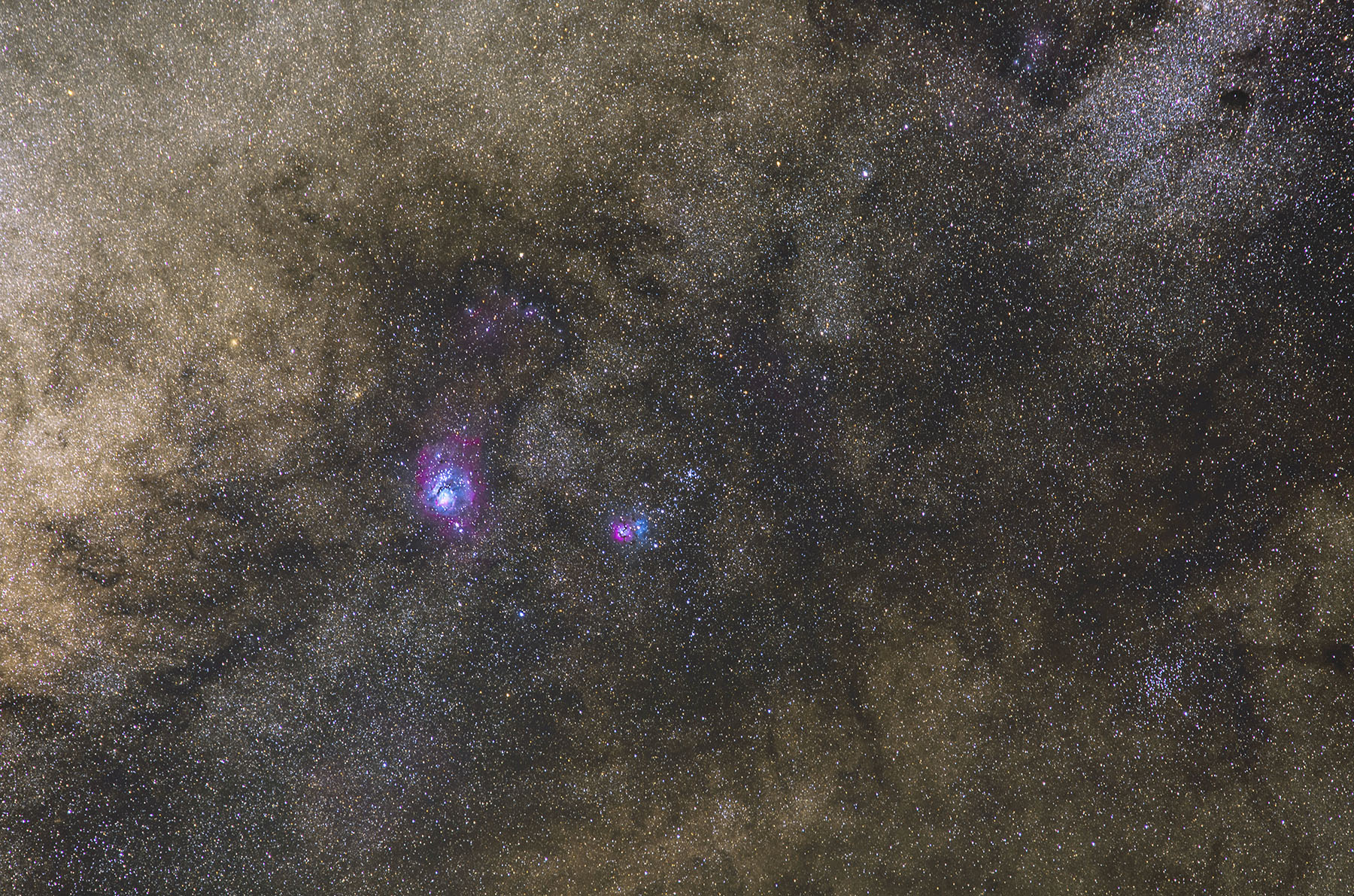
Wide field view around the Lagoon and the Trifid nebulae

2017_09_19_M20+M8_cboost_trim_small

The Trifid Nebula (M20), with its pink (left) and blue (right) colours, is at the center. The Lagoon Nebula (M 8) is at its left. Very close to M20 is the open cluster M21, almost in the very center of the image. The faint nebula IC 4685 is also seen over M 8. The open cluster M23 is located at the bottom right corner (this cluster has a similar size to the full moon in the sky). The diffuse nebula IC 1283 is located at the top right, in the middle of a dark cloud.

CANON EOS 5D Mark III with a Tamrom 200mm lens, 15 x 5 minutes exposure at f/2.8 and ISO 800.

Piggyback using my old mount, battery powered but very well polar-aligned, no autoguiding.

Full processed with Photoshop.

Siding Spring Observatory, Coonabarabran (NSW, Australia), 19 September 2017.

Full resolution image in my Flickr.
Credit: Ángel R. López-Sánchez (AAO-MQ).

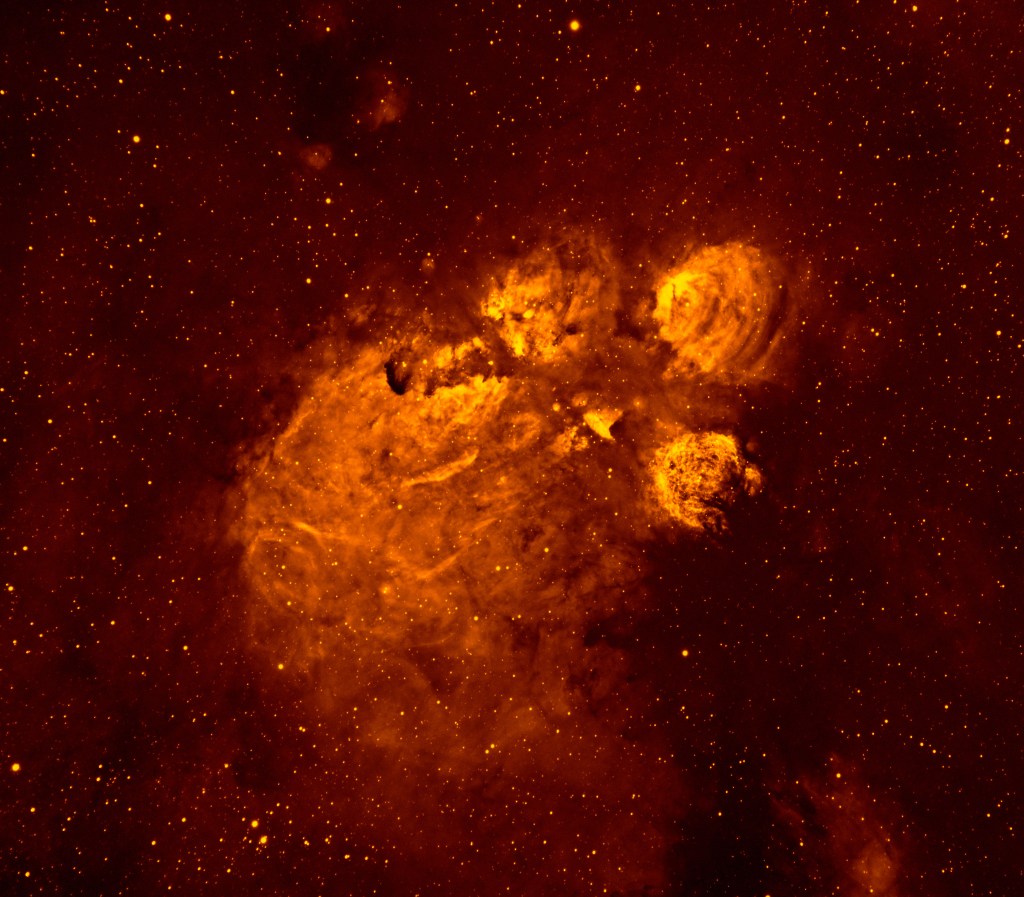
Fire in the Cat’s Paw Nebula

Deep H-alpha image of the Cat’s Paw Nebula (NGC 6334) in Scorpius obtained from my backyard, 15 km from Sydney’s city centre.

This image combines 40 frames I got during some few nights during late September and early October 2020 using the ZWO ASI1600MM Pro and the H-alpha Baader 3.5nm ultra-narrow filter.

All frames had an exposition time of 900s (15 minutes), hence this image combines a total of 10 hours of telescope time!

Telescope: Skywatcher Black Diamond 80, f=600mm (f/7.5)

Equipment: I used the ZWO ASIAir to control the camera, the mount (Skywatcher AZ-EQ6) and the guiding system (ASI120MM + Orion 50mm finderscope). The H-alpha filter was in the ZWO filter drawer.

Processing: Data processed with Siril software. FITS converted on TIFF using NASA’s Fits Liberator considering a logarithmic function. Color / saturation / levels / contrast / smart sharpen with Photoshop.

For this image I decided to give some false colour instead of just the greyscale image, I used Photoshop to get the kind of “fire” aspect to the gas in the nebulae.

I would love to get some data in broad-band filters to get the colours, but I’m afraid this will have to wait till next year, as Scorpius is already a bit too low over the western horizon, and some palm tress block the view from my backyard.

Full resolution image in my Flickr.

Credit: Ángel R. López-Sánchez (AAO-MQ).

A test of the Eagle Nebula from Sydney

A test of the Eagle Nebula from Sydney

This is my first test image of the Eagle Nebula (M 16) using my amateur equipment from my backyard, 15 km North from Sydney’s city center, on 1st July 2020.

This image compiles 32 x 300s images (2 hours 40 minutes total integration time) obtained with my Skywatcher Black Diamond 80, an Orion X0.8 focal reducer (f/6), the ZWO ASI178MC camera and an OPTOLONG L-Pro filter.

I used the ZWO ASIAir to control the camera, the mount (Skywatcher AZ-EQ6) and the guiding system (ASI120MM + Orion 50mm finderscope).

Flats and darks included. Data processed with Siril software. Color / saturation / levels / contrast / smart sharpen with Photoshop.

Full resolution image in my Flickr.

Credit: Ángel R. López-Sánchez (AAO-MQ).