Tag Archives: stars

Gas, star-formation and chemical enrichment in the spiral galaxy NGC 1512

How do galaxies grow and evolve? Galaxies are made of gas and stars, which interact in very complex ways: gas form stars, stars die and release chemical elements into the galaxy, some stars and gas can be lost from the galaxy, some gas and stars can be accreted from the intergalactic medium. The current accepted theory is that galaxies build their stellar component using their available gas while they increase their amount of chemical elements in the process. But how do they do this?

That is part of my current astrophysical research: how gas is processed inside galaxies? What is the chemical composition of the gas? How does star-formation happen in galaxies? How galaxies evolve? Today, 21st May 2015, the prestigious journal “Monthly Notices of the Royal Astronomical Society”, publishes my most recent scientific paper, that tries to provide some answers to these questions. This study has been performed with my friends and colleagues Tobias Westmeier (ICRAR), Baerbel Koribalski (CSIRO), and César Esteban (IAC, Spain). We present new, unique observations using the 2dF instrument at the 3.9m Anglo-Australian Telescope (AAT), in combination with radio data obtained with the Australian Telescope Compact Array (ATCA) radio-interferometer, to study how the gas in processed into stars and how much chemical enrichment has this gas experienced in a nearby galaxy, NGC 1512.

Deep images of the galaxy pair NGC 1512 and NGC 1510 using optical light (left) and ultraviolet light (right).Credit: Optical image: David Malin (AAO) using photographic plates obtained in 1975 using de 1.2m UK Schmidt Telescope (Siding Spring Observatory, Australia). UV image: GALEX satellite (NASA), image combining data in far-ultraviolet (blue) and near-ultraviolet (red) filters.

NGC 1512 and NGC 1510 is an interacting galaxy pair composed by a spiral galaxy (NGC 1512) and a Blue Compact Dwarf Galaxy (NGC 1510) located at 9.5 Mpc (=31 million light years). The system possesses hundreds of star-forming regions in the outer areas, as it was revealed using ultraviolet (UV) data provided by the GALEX satellite (NASA). Indeed, the UV-bright regions in the outskirts of NGC 1512 build an “eXtended UV disc” (XUV-disc), a feature that has been observed around the 15% of the nearby spiral galaxies. However these regions were firstly detected by famous astronomer David Malin (AAO) in 1975 (that is before I was born!) using photographic plates obtained with the 1.2m UK Schmidt Telescope (AAO), at Siding Spring Observatory (NSW, Australia).

The system has a lot of diffuse gas, as revealed by radio observations in the 21 cm HI line conducted at the Australian Telescope Compact Array (ATCA) as part of the “Local Volume HI Survey” (LVHIS) and presented by Koribalski & López-Sánchez (2009). The gas follows two long spiral structures up to more than 250 000 light years from the centre of NGC 1512. That is ~2.5 times the size of the Milky Way, but NGC 1512 is ~3 times smaller than our Galaxy! One of these structures has been somehow disrupted recently because of the interaction between NGC 1512 and NGC 1510, that it is estimated started around 400 million years ago.

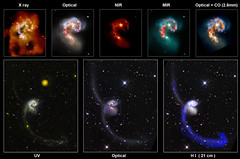
Multiwavelength image of the NGC 1512 and NGC 1510 system combining optical and near-infrared data (light blue, yellow, orange), ultraviolet data from GALEX (dark blue), mid-infrared data from the Spitzer satellite (red) and radio data from the ATCA (green). The blue compact dwarf galaxy NGC 1510 is the bright point-like object located at the bottom right of the spiral galaxy NGC 1512.
Credit: Ángel R. López-Sánchez (AAO/MQ) & Baerbel Koribalski (CSIRO).

Our study presents new, deep spectroscopical observations of 136 genuine UV-bright knots in the NGC 1512/1510 system using the powerful multi-fibre instrument 2dF and the spectrograph AAOmega, installed at the 3.9m Anglo-Australian Telescope (AAT).

2dF/AAOmega is generally used by astronomers to observe simultaneously hundreds of individual stars in the Milky Way or hundreds of galaxies. Without considering observations in the Magellanic Clouds, it is the first time that 2dF/AAOmega is used to trace individual star-forming regions within the same galaxy, in some way forming a huge “Integral-Field Unit” (IFU) to observe all the important parts of the galaxy.

Two examples of the high-quality spectra obtained using the AAT. Top: spectrum of the BCDG NGC 1510. Bottom: spectrum of one of the brightest UV-bright regions in the system. The important emission lines are labelled.
Credit: Ángel R. López-Sánchez (AAO/MQ), Tobias Westmeier (ICRAR), César Esteban (IAC) & Baerbel Koribalski (CSIRO).


The AAT observations confirm that the majority of the UV-bright regions are star-forming regions. Some of the bright knots (those which are usually not coincident with the neutral gas) are actually background galaxies (i.e., objects much further than NGC 1512 and not physically related to it) showing strong star-formation activity. Observations also revealed a knot to be a very blue young star within our Galaxy.

Using the peak of the H-alpha emission, the AAT data allow to trace how the gas is moving in each of the observed UV-rich region (their “kinematics”), and compare with the movement of the diffuse gas as provided using the ATCA data. The two kinematics maps provide basically the same results, except for one region (black circle) that shows a very different behaviour. This object might be an independent, dwarf, low-luminosity galaxy (as seen from the H-alpha emission) that is in process of accretion into NGC 1512.

Map showing the velocity field of the galaxy pair NGC 1512 / NGC 1510 as determined using the H-alpha emission provided by the AAT data. This kinematic map is almost identical to that obtained from the neutras gas (HI) data using the ATCA, except for a particular region (noted by a black circle) that shows very different kinematics when comparing the maps.
Credit: Ángel R. López-Sánchez (AAO/MQ), Tobias Westmeier (ICRAR), César Esteban (IAC) & Baerbel Koribalski (CSIRO).

The H-alpha map shows how the gas is moving following the optical emission lines up to 250 000 light years from the centre of NGC 1512, that is 6.6 times the optical size of the galaxy. No other IFU map has been obtained before with such characteristics.

Using the emission lines detected in the optical spectra, which includes H I, [O II], [O III], [N II], [S II] lines (lines of hydrogen, oxygen, nitrogen and sulphur), we are able to trace the chemical composition -the “metallicity”, as in Astronomy all elements which are not hydrogen or helium as defined as “metals”- of the gas within this UV-bright regions. Only hydrogen and helium were created in the Big Bang. All the other elements have been formed inside the stars as a consequence of nuclear reactions or by the actions of the stars (e.g., supernovae). The new elements created by the stars are released into the interstellar medium of the galaxies when they die, and mix with the diffuse gas to form new stars, that now will have a richer chemical composition than the previous generation of stars. Hence, tracing the amount of metals (usually oxygen) within galaxies indicate how much the gas has been re-processed into stars.


Metallicity map of the NGC 1512 and NGC 1510 system, as given by the amount of oxygen in the star-forming regions (oxygen abundance, O/H). The colours indicate how much oxygen (blue: few, green: intermediate, red: many) each region has. Red diamonds indicate the central, metal rich regions of NGC 1512. Circles trace a long, undisturbed, metal-poor arm. Triangles and squares follow the other spiral arms, which is been broken and disturbed as a consequence of the interaction between NGC 1512 and NGC 1510 (blue star). The blue pentagon within the box in the bottom right corner represents the farthest region of the system, located at 250 000 light years from the centre.
Credit: Ángel R. López-Sánchez (AAO/MQ), Tobias Westmeier (ICRAR), César Esteban (IAC) & Baerbel Koribalski (CSIRO).


The “chemical composition map” or “metallicity map” of the system reveals that indeed the centre of NGC 1512 has a lot of metals (red diamonds in the figure), in a proportion similar to those found around the centre of our Milky Way galaxy. However the external areas show two different behaviours: regions located along one spiral arm (left in the map) have low amount of metals (blue circles), while regions located in other spiral arm (right) have a chemical composition which is intermediate between those found in the centre and in the other arm (green squares and green triangles). Furthermore, all regions along the extended “blue arm” show very similar metallicities, while the “green arm” also has some regions with low (blue) and high (orange and red) metallicities. The reason of this behaviour is that the gas along the “green arm” has been very recently enriched by star-formation activity, which was triggered by the interaction with the Blue Compact Dwarf galaxy NGC 1510 (blue star in the map).

When combining the available ultraviolet and radio data with the new AAT optical data it is possible to estimate the amount of chemical enrichment that the system has experienced. This analysis allows to conclude that the diffuse gas located in the external regions of NGC 1512 was already chemically rich before the interaction with NGC 1510 started about 400 million years ago. That is, the diffuse gas that NGC 1512 possesses in its outer regions is not pristine (formed in the Big Bang) but it has been already processed by previous generations of stars. The data suggest that the metals within the diffuse gas are not coming from the inner regions of the galaxy but very probably they have been accreted during the life of the galaxy either by absorbing low-mass, gas-rich galaxies or by accreting diffuse intergalactic gas that was previously enriched by metals lost by other galaxies.

In any case this result constrains our models of galaxy evolution. When used together, the analysis of the diffuse gas (as seen using radio telescopes) and the study of the metal distribution within galaxies (as given by optical telescopes) provide a very powerful tool to disentangle the nature and evolution of the galaxies we now observe in the Local Universe.

More information

Scientific Paper in MNRAS: “Ionized gas in the XUV disc of the NGC 1512/1510 system”. Á. R. López-Sánchez, T. Westmeier, C. Esteban, and B. S. Koribalski.“Ionized gas in the XUV disc of the NGC1512/1510 system”, 2015, MNRAS, 450, 3381. Published in Monthly Notices of the Royal Astronomical Society (MNRAS) through Oxford University Press.

AAO/CSIRO/ICRAR Press Release (AAO): Galaxy’s snacking habits revealed

AAO/CSIRO/ICRAR Press Release (ICRAR): Galaxy’s snacking habits revealed

Royal Astronomical Society (RAS) Press Release: Galaxy’s snacking habits revealed

Article in Phys.org: Galaxy’s snacking habits revealed

Article in EurekAlert!: Galaxy’s snacking habits revealed

Article in Press-News.org: Galaxy’s snacking habits revealed

Article in Open Science World: Galaxy’s snacking habits revealed

ATNF Daily Astronomy Picture on 21st May 2015.

Timelapse video: The Sky over the Anglo-Australian Telescope

A dark winter night, with the Milky Way crossing the firmament while its center in located near the zenith, is one of the most astonishing views we can enjoy. This vision is only obtained from the Southern Hemisphere and it is really inspiring. In particular, the Milky Way shines over the Siding Spring Observatory, near Coonabarabran (NSW), where the famous Anglo-Australian Telescope (AAT) is located. With the idea of sharing the beauty of the night sky to everybody, in May 2011 I decided to start taking timelapse photography while I was working as support astronomer at the AAT. This technique consists on taking many images and then adding all to get a movie with a very high resolution. The best shots I obtained by September 2011 were included in the video The Sky over the Anglo-Australian Telescope, which is available both in YouTube and in several MOV/MP4 files (HD, iPad, iPhone) in my personal AAO webpage.


“The Sky over the Anglo-Australian Telescope” was my first public timelapse video, released in November 2011.
Credit: Ángel R. López-Sánchez (AAO/MQ), the credit of the music is Echoes from the past, by Dj Fab.

The video, which lasts for 2.7 minutes, is the results of combining around 3800 different frames obtained using a CANON EOS 600D between June and September 2011. Except for those frames used for the sunset in the first scene, all frames have a 30 seconds exposure time, with a ISO speed of 1600. As the videos were created at 24 fps (frames per second), each second in the movie corresponds to 12 minutes in real time. I used several lens to take the images (standard 50 mm, 50mm x 0.65 focal reducer and a 10 mm wide-angle lens). The focal chosen was 5.6 (for the 50 mm lens) or 4.5 (10 mm wide-angle lens). Processing each sequence of the movie took five to six hours of computer time, and usually I had to repeat this at least once for each sequence, to improve the quality. The soundtrack I chose is an extract of the music Echoes from the past, by the french composer Dj Fab, which gives energy to the timelapse.

The Milky Way is setting at Siding Spring Observatory on 21 Sep 2011.
Click here to get the full resolution frame.
Credit: Á.R. L-S.

As my main job while I’m at the AAT is providing instrumental and scientific support to the astronomers who are observing in this telescope, I always set the camera up at the beginning of the night, let it run, and check on its progress occasionally. Sometimes this was not easy: wind knocked the camera over on a couple of times, often the battery ran out, and even once I had an encounter with some intransigent kangaroos. However, finally I got this material, which does not only show the magnificent Milky Way rising and setting above the dome of the AAT, but also stars circling the South Celestial Pole, the Magellanic Clouds over the AAT, satellites and airplanes crossing the sky, the Moon rising and setting, and the most famous constellations as Orion, Carina and the Southern Cross.

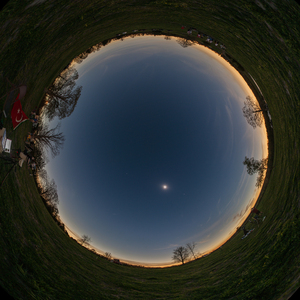
Circumpolar star traces (2.7 hours) over the Anglo-Australian Telescope on 20 Sep 2011.
Click here to get the full resolution frame.
Credit: Á.R. L-S.

I hope you enjoy the result. More timelapse videos to come soon!

The importance of massive stars

The mass range of stars drawing their energy supply from nuclear fusion covers about three orders of magnitude. The least massive stars known have masses around 0.1 solar masses (M) and the most massive examples are around 100 M, although stars with masses of ~150M may also exist.

Massive stars are defined as those stars with masses higher than around 8 M. However, this lower limit is not completely fixed, as the definition of massive star actually comes from those stars that ignite helium and afterwards carbon in non-degenerated stellar cores (i.e., the hydrostatic equilibrium is reached because the inward gravitational force is balanced with the outward force due to the pressure gradient of the gas). Depending on the evolutionary scenario, this happens between 7 and 9 M.

Massive stars consume their fuel faster than low and intermediate mass stars: a solar-mass star has a life ~125 times longer than a 10 M star. Massive stars also are very luminous: a 100M star shines with a luminosity similar to ~1600 Suns. Hence, except for stars of transient brightness, like novae and supernovae, hot, massive stars are the most luminous stellar objects in the Universe.

STScI-01EVT9Y2MZMV5XAMN6ATWKA46C

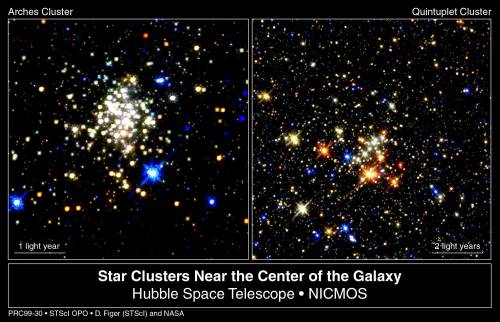
Young, massive star clusters near the center of the Milky Way, at ~25,000 light-years from Earth: the Arches cluster (left) and the Quintuplet Cluster (right). Both pictures were taken using infrared filters by the NICMOS camera of the Hubble Space Telescope in September 1997. The galactic center stars are white, the red stars are enshrouded in dust or behind dust, and the blue stars are foreground stars between us and the Milky Way’s center. The clusters are hidden from direct view behind black dust clouds in the constellation Sagittarius. Credit: Don Figer (STScI) and NASA.

Massive stars are, however, extremely rare. Following the very famous results obtained by the Austrian-Australian-American astrophysicist Edwin Ernest Salpeter in 1955, the number of stars formed per unit mass interval is roughly proportional to M -2.35. Therefore we expect to find only very few massive stars in comparison with solar-type stars: for each 20M star in the Milky Way there are roughly a hundred thousand solar-type stars; for each 100M star there should be over a million solar-type stars.

However, despite their relative low number, massive stars have a fundamental influence over the interstellar medium and galactic evolution because they are the responsible of the ionization of the surrounding gas and they deposit mechanical energy first via strong stellar winds and later as supernovae, enriching the interstellar medium by returning unprocessed and nuclear processed material during their whole life. Massive stars therefore condition their environment and supply it with new material available for the birth of new generations of stars, being even the triggering mechanism of star formation. They also generate most of the ultraviolet ionization radiation in galaxies, and power the far-infrared luminosities through the heating of dust. The combined action of stellar winds and supernovae explosions in massive young stellar clusters leads to the formation of super-bubbles that may derive in galactic super-winds. Furthermore, massive stars are the progenitors of the most energetic phenomenon nowadays found, the gamma-ray bursts (GRBs), as they collapse as supernova explotions into black holes. Particularly, the interest in hot luminous stars has increased in the last decade because of the massive star formation at high redshift and the results of numerical simulations regarding the formation of the firts stars at zero metallicity (Population III stars), that are thought to be very massive stars with masses around 100M.

The descents of the most massive, extremely hot (temperatures up to 200,000 K) and very luminous (105  to 106 solar luminosities, L) O stars are Wolf-Rayet stars, which have typical masses of 25 – 30 M for solar metallicity.

What are Wolf-Rayet stars?

Wolf-Rayet (WR) stars are the evolved descents of the most massive, extremely hot (temperatures up to 200,000 K) and very luminous (105  to 106 solar luminosities, L) O stars, with masses 25 – 30 solar masses (M) for solar metallicity. WR stars possess very strong stellar winds, which reach velocities up to 3,000 km/s. These winds are observed in the broad emission line profiles (sometimes, even P-Cygni profiles) of WR spectra in the optical and UV ranges. These strong winds are also attributed to atmospheres in expansion. Actually, these winds are so strong that they are peeling the star and converting it in a nude nucleus without envelope. Indeed, WR stars have ejected their unprocessed outer Hydrogen-rich layers. WR stars typically lose 10−5 M a year; in comparison the Sun only loses  10−14  M⊙  per year.

Hα image of the Population I Wolf-Rayet star WR 124 (WN8) showing a young circunstelar envelope that is ejected at velocities highest than 300 km/s. The chaotic and filamentary structure created forms the M 1-67 nebula. The star is located at about 4.6 kpc from the Sun. At the left, image obtained by the author using the IAC-80 telescope, combining filters Hα (red) Hα continuum (green) and [O III] (blue). The right Hα image was obtained by the Hubble Space Telescope WFPC2 (Grosdidier et al. 1998). Note that the large arcs of nebulosity extend around the central star yet with not overall global shell structure. Furthermore, numerous bright knots of emission occur in the inner part of the nebula, often surrounded by what appear to be their own local wind diffuse bubbles. The dashed square in the IAC-80 image indicates the size of the HST image.

This is Figure 2.1 in my PhD Thesis.

WR stars were discovered by French astronomers Charles Wolf and Georges Rayet in 1867. They found that three bright galactic stars located at Cygnus region have, rather than absorptions lines, broad strong emission bands superposed to the typical continuum of hot stars. In 1930 C.S Beals correctly identified these features as emission lines produced by high ionized elements as helium, carbon, nitrogen and oxygen.  The intriguing spectral appearance of WR stars is due both their strong stellar winds and highly evolved surface chemical abundance. In 1938, WR stars were subdivided into WN (nitrogen-rich) and WC (carbon-rich) depending on whether the spectrum was dominated by lines of nitrogen or carbon-oxygen , respectively. Not until the 1980s did it became clear that WR stars represent an evolutionary phase in the lives of massive stars during which they undergo heavy mass loss. 

The mass-loss occurs via a continuous stellar wind which accelerated from low velocities near the surface of the star to velocities that exceed the surface escape speed. Their spectra, originated over a range of radii with the optical continuum forming close the stellar core and the emission lines in the more external areas (even beyond 10 stellar radii), indicate that the WR stars are embedded in luminous and turbulent shells of ejecta owing outwards at speeds comparable to the expansion velocities of novae although, in the case of WR stars, the expanding shell is being constantly fed with material from the main body of the star.

WR stars are extremely rare, reflecting their short lifespan. Indeed, they live for only some few hundred of thousands years, and hence only few WR stars are known: about 500 in our Milky Way and 100 in the Large Magellanic Cloud. Indeed, because of their peculiarities (brightness and broad emission lines), WR stars can be detected in distant galaxies. A galaxy showing features of WR stars in its spectrum is known as a Wolf-Rayet galaxy.

I compiled the main characteristics of WR stars in Chapter 2 of my PhD Thesis. A recent review about the properties of WR stars was presented by Crowther (2007).