Blog Archives

Image

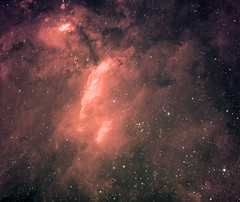
Test of M8 from Sydney

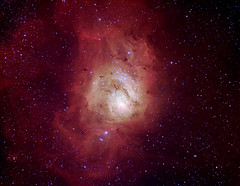
Test image of M 8 (The Lagoon Nebula) from my backyard, 15 km North from Sydney’s city center, on 21st Aug 2019.

That was my first attempt to get the new equipment working. I was testing the Skywatcher AZ-EQ6 mount and the ZWO ASI120MM (guiding) and ZWO ASI178MC (main camera) with the ASIair. But I had plenty of problems to get the guiding working as the mount was not properly aligned to the South Celestial Pole (over Sydney, very difficult to see the faint stars using the polar scope of the mount). I had to use the drift method. After that, getting the ASIair properly guiding was hard as I couldn’t find any easy manual and never used PHD for guiding before.

This image combines 25 (of a series of 60) good 180s frames using the ZWO 183MC and my Skywatcher Black Diamond 80 (F=600mm, f/7.5. No darks, flats, biases or light pollution filter was used for this.

Later it was also tricky for me to play with the raw data: I have never used a color camera producing .FITS files before! It took me some time to get a good free(*) software for it and I found Siril. But the “bayer” decomposition didn’t work well with the ZWO cameras and my images had very weird colours.

In March 2020 I learnt a couple of extra things, including changing the bayer matrix from RGGB to GBRG for ZWO cameras and… bingo! So here it is the test image I got that night more than half a year ago! And still testing the equipment!

Ah, yes, stretching, colour contrast, saturation, levels, and luminosity with Photoshop.

Full resolution image in my Flickr.

Credit: Ángel R. López-Sánchez (AAO-MQ).

(*) Don’t get me wrong… I’ll get PixInsight eventually, when I get everything working well.

Image

The Milky Way over Siding Spring Observatory

Milky Way over SSO

The Milky Way over Siding Spring Observatory, on Friday 23rd Aug 2019, 9pm local time, during a Stargazing event as part of a tour for Australian Geographic.

10 x 30 seconds exposures taken using a camera is a CANON 5D Mark III in a tripod (no tracking). The lens was a Samyang 14mm at f2.8.

RAW to TIFF conversion in Photoshop, star alignment and median stacking with Siril software.

The high-resolution image is available in my Flickr.

Credit: Ángel R. López-Sánchez (Australian Astronomical Optics, Macquarie University) + all participants.

Image

The Galaxy and me

The Galaxy and me

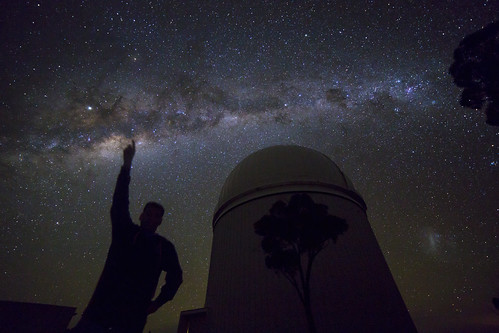
The Anglo-Australian Telescope, The Emu in the Sky (The Milky Way), the Southern Cross, Carina Nebula, Large Magellanic Cloud, Jupiter, Saturn… and me! Single 15s shot using a CANON 5D Mark III with a 14mm lens at f2.8, 1600ISO. Photo taken at 1.15am AEST, Saturday 6th April 2019.

Full resolution image in my Flickr.

Credit: Ángel R. López-Sánchez (Australian Astronomical Optics, Macquarie University).

Image

Eta Carinae and the Keyhole Nebula

Eta Carinae and the Keyhole Nebula

Diffuse gas and dust in the heart of the Carina Nebula. The bright star is Eta Carinae, a massive double star at the end of its live that will soon explode as a supernova. The “Keyhole” is the dark cloud in the centre of the image.

Image obtained as part of the “ABC Stargazing Live” events at Siding Spring Observatory (NSW, Australia), 4 – 6 April 2017.

Data taken on 3rd April 2017 using the CACTI camera in 2dF at the 3.9m Anglo-Australian Telescope. Color image using B (12 x 60s, blue) + [O III] (12 x 60 s, green) + Hα (12 x 60 s, red) filters.

More sizes and high-resolution image in my Flickr.

Credit: Ángel R. López-Sánchez (Australian Astronomical Observatory and Macquarie University), Steve Lee, Robert Patterson & Robert Dean (AAO), Night assistant at the AAT: Wiston Campbell (AAO).

Image

Milky Way rising, LMC, and AAT

Milky Way rising, LMC & AAT

Milky Way, Large Magellanic Cloud, and Anglo-Australian Telescope. Combination of. 6  frames, each of 30 seconds, CANON EOS 5D Mark III, 16mm, f/2.8, ISO 1600. Thursday 2 March 2017. The dome was illuminated in one of the frames by a car leaving the building.

More sizes and high-resolution image in my Flickr.

Credit: Ángel R. López-Sánchez (AAO/MQU).